Bridging Virtual Card Games and Racetrack Predictions: Insight Transfers in Handicapping
Written by David Becker · Jun 2, 2026

Bridging Virtual Card Games and Racetrack Predictions: Insight Transfers in Handicapping
Digital poker platforms have long emphasized real-time probability assessments and opponent modeling that now find direct applications in horse race handicapping models where data layers accumulate from past performances, track variants, and pace scenarios. Researchers at institutions such as the University of Sydney have documented how expected value calculations, originally refined in online poker environments, translate into equine selection frameworks that weigh multiple variables simultaneously rather than relying on single-factor speed figures.
Handicappers who study poker dynamics notice that concepts like implied odds and fold equity mirror the way race analysts project whether a horse can sustain early speed or conserve energy for a late surge against specific competition. Data from Australian racing authorities shows that models incorporating multi-street decision trees, similar to those used in no-limit hold'em solvers, improve place prediction accuracy by accounting for pace collapses and traffic patterns that static ratings often overlook.
Probability Frameworks Shared Across Both Domains
Poker software tracks ranges and equity realization over thousands of simulated hands, while equine models aggregate thousands of race replays to estimate sectional times under varying conditions, and both systems rely on Bayesian updating when new information arrives mid-event. Observers note that variance management techniques developed for poker bankrolls apply equally to staking plans across race meetings where short-term results fluctuate despite long-term edges derived from superior modeling.
Studies conducted in Canada during 2025 revealed that bettors trained in poker range construction produced handicapping outputs that outperformed traditional form experts when evaluating maidens and lightly raced horses, because they treated each runner as holding a distribution of possible outcomes instead of a fixed rating. Those distributions update continuously as post positions, weather reports, and jockey bookings become available, much like a poker player adjusts ranges after each community card appears.
Pattern Recognition and Opponent Modeling Techniques
Digital poker players routinely build profiles of opponents based on betting frequencies and timing tells, and the same profiling logic extends to trainers and jockeys whose historical patterns emerge from large datasets. Handicapping software now records how certain stables perform when shipping horses to specific tracks or when deploying first-time blinkers, allowing quantitative adjustments that parallel poker HUD statistics.
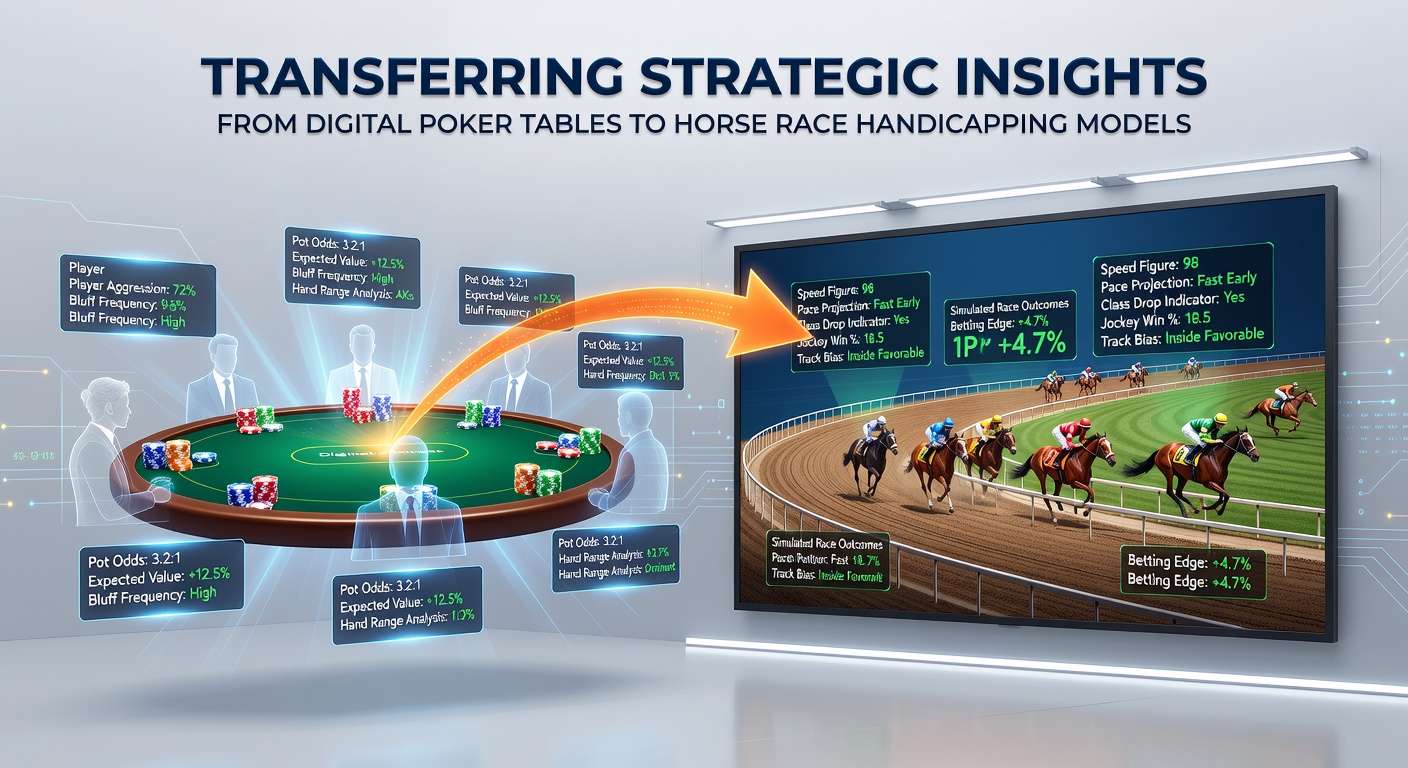
June 2026 brought additional computational power to these crossover applications when European data providers released expanded sectional timing feeds that integrate with existing poker-derived simulation engines. Analysts report that models combining Monte Carlo methods from poker with detailed equine GPS data generate more robust forecasts for races featuring contested early fractions or unusual rail biases.
Bankroll Allocation and Risk Calibration Parallels
Both disciplines require disciplined allocation of resources across multiple opportunities while preserving capital during downswings. Poker players who master Kelly criterion sizing find the same formula useful when determining bet sizes on horses whose modeled probabilities exceed public odds by measurable margins. Industry reports from New Zealand thoroughbred racing confirm that syndicates applying poker-style risk management reduced drawdown periods compared with conventional fixed-stake approaches.
Software developers have begun releasing integrated tools that import poker equity calculators and repurpose them for race simulations, letting users adjust variables such as pace scenarios and post biases in real time. These platforms draw on academic research from institutions in Japan that examined decision theory across gambling formats, highlighting structural similarities in how skilled participants process incomplete information.
Conclusion
Transfer mechanisms between digital poker and horse race handicapping continue to expand as datasets grow larger and algorithms become more sophisticated. Regulatory bodies in multiple jurisdictions track these developments because improved modeling accuracy influences both recreational participation and operator risk management. The ongoing convergence of these analytical traditions demonstrates how quantitative disciplines developed in one arena readily inform performance forecasting in another when underlying probability structures align.