RNG Certification: The Backbone of Fairness in Online Casino Games
Written by Zoe Flores · Jun 19, 2026
RNG Certification: The Backbone of Fairness in Online Casino Games
Virtual casino platforms rely on random number generators to produce unpredictable outcomes in games such as slots, roulette, and blackjack, and certification standards exist to verify that these systems meet established statistical criteria for fairness. Observers note that independent testing laboratories evaluate RNG software against benchmarks set by regulatory authorities and technical bodies, while operators must demonstrate ongoing compliance through periodic audits.
Core Components of Random Number Generator Systems
Random number generators in casino software fall into two main categories: hardware-based devices that use physical entropy sources like thermal noise or radioactive decay, and software-based algorithms that employ cryptographic functions to simulate randomness. Researchers at institutions such as the National Institute of Standards and Technology have documented how both types undergo statistical testing suites including the Diehard battery and the NIST SP 800-22rev1a suite, which check for uniformity, independence, and absence of bias across millions of generated sequences. Operators integrate these RNG modules into game engines so that each spin or card draw draws from a fresh sequence that passes the required distribution tests.
International Regulatory Frameworks and Testing Bodies
Regulatory bodies in multiple jurisdictions maintain lists of approved testing laboratories that operators must use before launching games. The Nevada Gaming Control Board requires all RNG submissions to undergo evaluation by labs accredited under ISO/IEC 17025 standards, while the Malta Gaming Authority accepts reports from entities that demonstrate compliance with its RNG technical specifications document. In Australia, the Northern Territory Racing Commission oversees similar requirements through its approved testing partners, creating a patchwork of rules that global operators navigate when deploying games across borders. Industry associations such as the Gaming Standards Association publish technical bulletins that help align these regional approaches, although each authority retains final approval rights.
Testing laboratories apply both static code review and dynamic runtime analysis during certification, examining source code for predictable patterns and running live simulations that generate at least ten million outcomes per game variant. When anomalies appear, developers must adjust seeding mechanisms or entropy collection routines before resubmission.
Certification Workflow and Ongoing Compliance
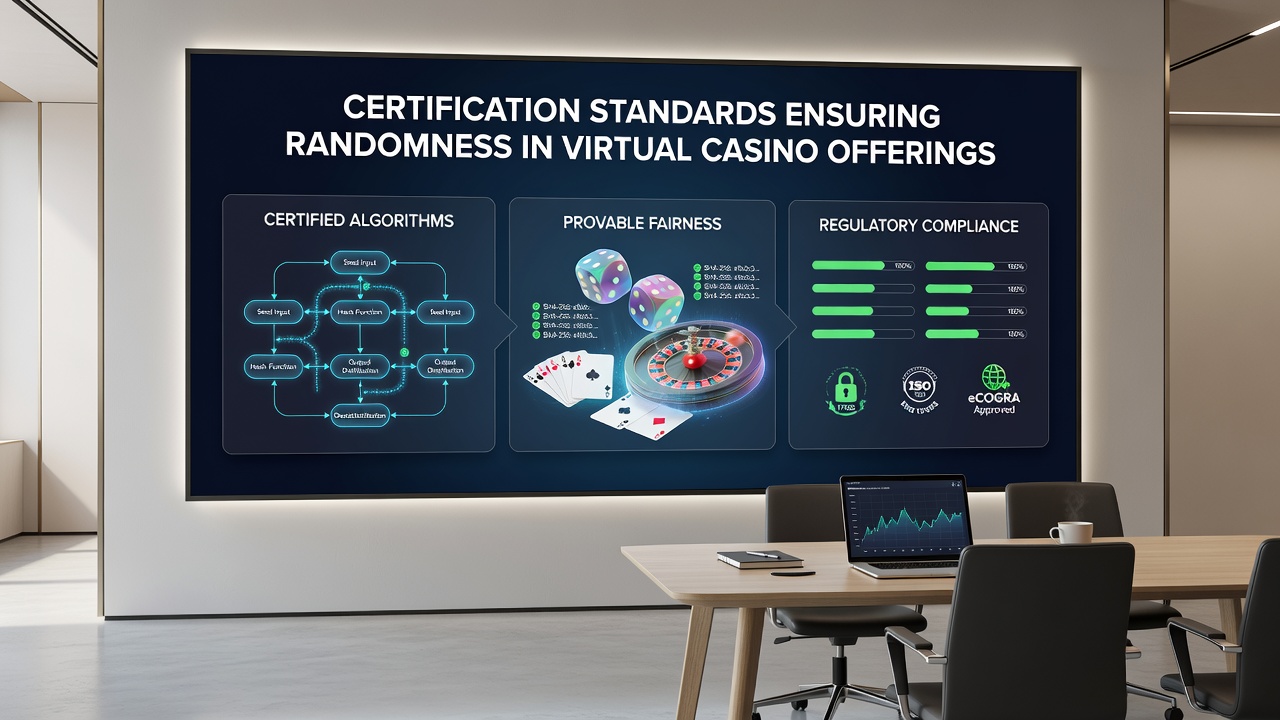
The typical certification workflow begins when an operator submits game software and supporting documentation to an approved lab, which then conducts initial evaluation, issues a report, and forwards findings to the relevant regulator. Approval timelines range from four to twelve weeks depending on game complexity and lab workload, after which the operator receives a certificate valid for a defined period, often twelve months. Renewals require fresh testing because RNG implementations can drift when integrated with new platform updates or when entropy sources degrade over time.
Remote monitoring tools now allow some regulators to receive real-time statistical feeds from live games, enabling them to flag deviations without waiting for scheduled audits. In June 2026 several North American and European authorities began piloting shared data exchange protocols that let labs compare performance metrics across multiple jurisdictions, reducing duplicate testing while preserving each regulator's oversight role.
Technical Standards and Statistical Benchmarks
Certification standards reference specific quantitative thresholds, such as requiring that symbol frequencies in slot games fall within 0.1 percent of theoretical probabilities over sample sizes exceeding one hundred million spins. Laboratories also verify that return-to-player percentages advertised by operators match the mathematical models embedded in the certified RNG code. Documentation from the Australian Communications and Media Authority outlines additional requirements for jackpot controllers and bonus round triggers, ensuring these features do not introduce predictable patterns that could be exploited.
Academic studies published in peer-reviewed journals have examined correlations between RNG certification rigor and player retention metrics, although such research remains observational rather than prescriptive. Those who administer certification programs emphasize that the goal is consistent statistical behavior rather than any guarantee of individual player outcomes.
Emerging Technologies and Future Directions
Quantum random number generators have entered limited commercial testing, with early adopters seeking certification pathways that extend existing statistical suites to account for quantum entropy properties. Standards organizations are drafting supplementary test protocols for these devices, drawing on work from national metrology institutes in Canada and Germany. Meanwhile, blockchain-based provably fair systems offer an alternative verification model where players can independently check game outcomes against published seeds, yet most regulatory frameworks still require traditional RNG certification alongside any decentralized solution.
Conclusion
Certification standards for randomness in virtual casino offerings continue to evolve through collaboration among regulators, laboratories, and standards bodies across multiple continents. Operators that maintain current certifications demonstrate adherence to documented statistical criteria, while players encounter game outcomes produced by systems that have passed established testing regimens. As new technologies emerge, the same principles of independent evaluation and periodic retesting remain central to maintaining the integrity of digital gambling platforms.